

Some stories begin with a woman. Not with a war, a king, or a monster. With a woman. In Greek mythology, that woman was called Pandora. And her story is far stranger — and considerably darker — than the popular version of the curious young woman who opened a box and let all the evils of the world escape.
Because Pandora didn't receive a box. And, in the oldest surviving account, she wasn't even created as an ordinary woman. She was a punishment.
The Origin: A Punishment Disguised as a Gift
To understand Pandora, we need to go back a little. Prometheus was one of the Titans and, according to Hesiod's account, had a confrontation with Zeus related to humankind. The most famous episode is the theft of fire: Prometheus obtained fire and gave it to men. For Zeus, this was too much. He decided that humans would pay for having received a gift that wasn't meant for them. The answer was Pandora.
In Works and Days, Hesiod recounts that Zeus ordered Hephaestus to mold a woman out of earth. Afterward, different gods contributed their gifts: Athena adorned her and taught her skills, Aphrodite gave her grace and charm, and Hermes granted her, among other things, a nature capable of deception and persuasion. Each god contributed something. From this comes the name Pandora, usually understood as "the one who received all gifts" or "all-gifted."
And here begins one of the most interesting ironies of the myth. Pandora appears to be a gift, but she is actually part of the punishment. The gods are creating something wonderful to give to men, and precisely because of that, she is dangerous.
The Poisoned Gift
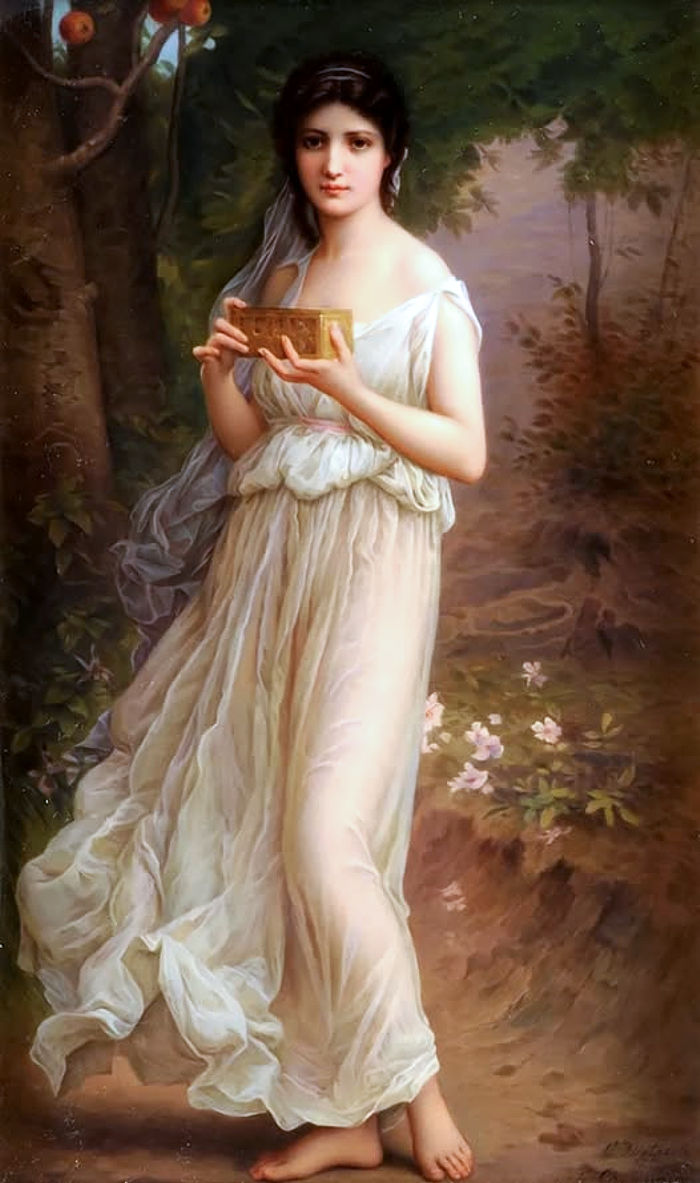
Pandora was brought to Epimetheus, Prometheus's brother. His name is also rather fitting: Prometheus can be linked to the idea of "foresight"; Epimetheus, to that of one who understands things only after they happen. Prometheus had already warned his brother not to accept gifts from Zeus. Epimetheus, however, accepted Pandora. And with her came a vessel.
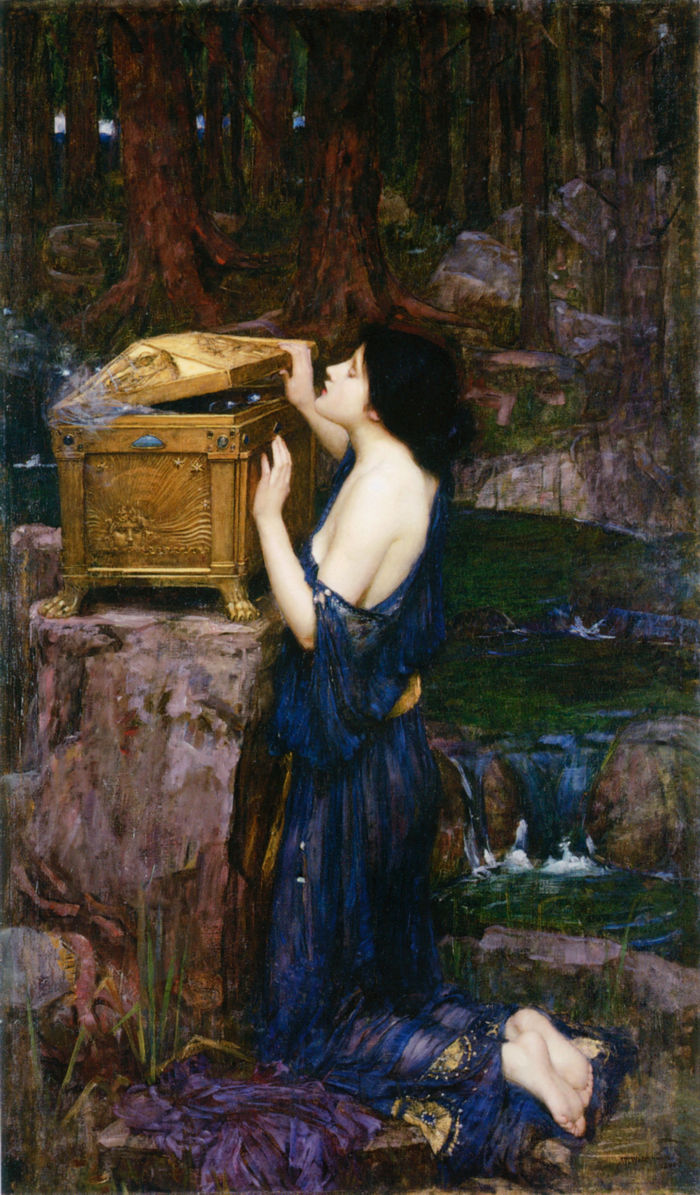
Here we need to pause, because the version we all know contains one of history's great errors: Pandora did not open a box. Hesiod speaks of a pithos, a large vessel or jar. The famous "Pandora's box" appeared much later in the European tradition, through a long history of translations and reinterpretations. The transformation of the vessel into a box is especially tied to the Latin tradition and the Renaissance reception of the myth.
So, if we want to picture the original scene, we need to forget about a small, elegant box. Pandora stood before a large jar. And inside it was something no human being would have wanted to find.
The Moment Everything Changed
Pandora opened the vessel, and the evils inside scattered across the world. Hesiod speaks of countless misfortunes that began to afflict human beings: diseases, suffering, and every kind of evil that until then had remained outside the everyday experience of men. Pandora tried to close the vessel, but it was already too late.
Only one thing remained inside: Elpis. Hope.
And here lies one of the most fascinating details of the entire myth. For centuries, it has been told that Pandora managed to keep hope as a small consolation against all the evils of the world. It's a very appealing interpretation, but it isn't so simple.
Scholars have long debated what it exactly means for Elpis to remain inside the vessel. Is Hope something good left behind as a comfort for humans? Or does its remaining inside the jar mean that humanity was deprived of it? Is it a blessing, or even a form of deception? There is no absolutely undisputed answer: the very structure of Hesiod's passage has sparked debate among specialists, precisely because of Elpis's strange role.
That's why it's better not to turn a later interpretation into a fact. What is certain is that the evils escape and Elpis remains inside. What that final image actually means remains one of the most fascinating parts of the myth.
What Does Pandora Have to Do With Eve?
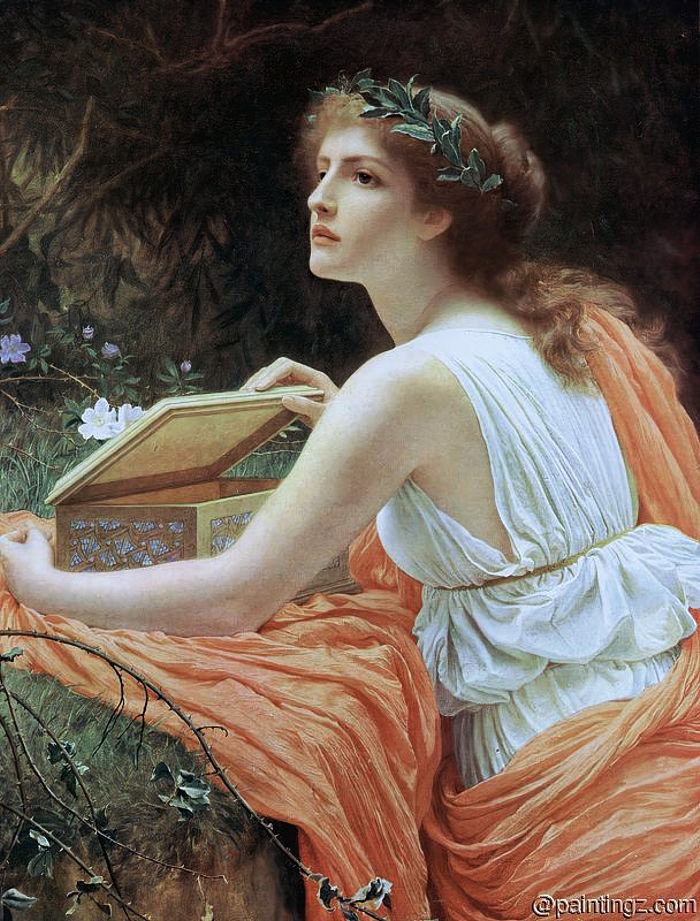
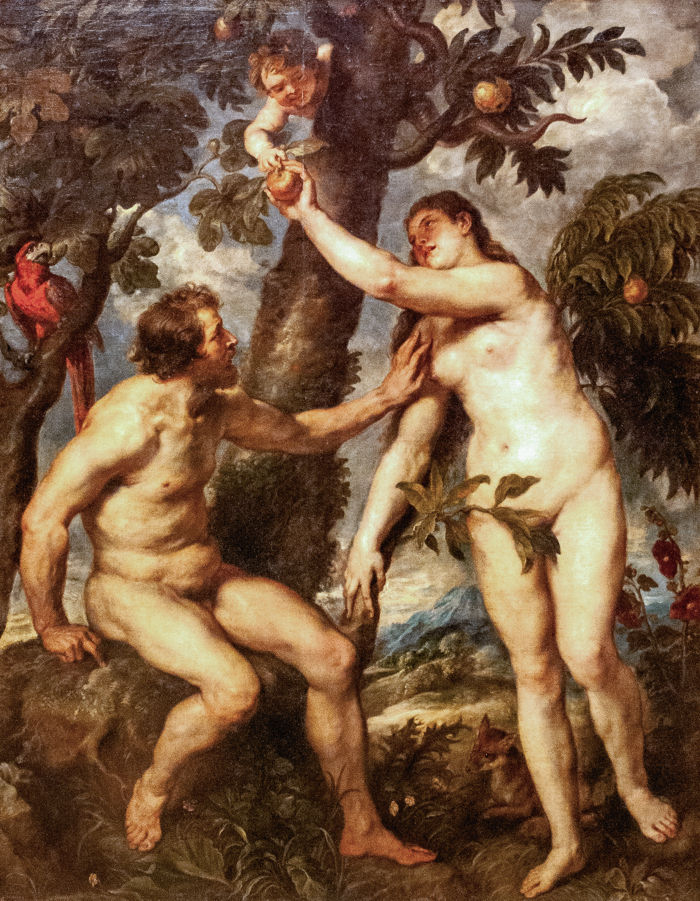
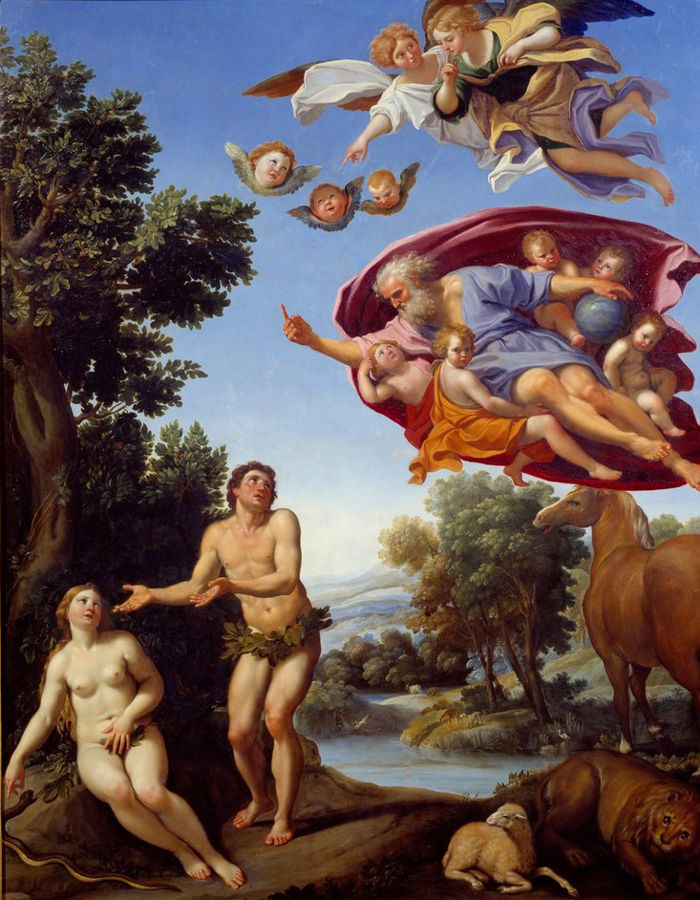
Here appears the parallel that makes this story even more interesting. Pandora and Eve belong to different traditions: Pandora to Greek mythology, Eve to the Genesis account. We don't need to claim that one story was copied from the other, but both ended up occupying a strikingly similar place in the Western imagination.
Both appear as first women. Both are tied to a moment of rupture. And in both stories, after a seemingly simple act, the human condition changes.
Eve lives in the Garden of Eden; Pandora arrives in the world of men. Eve encounters a prohibition; Pandora encounters a vessel. Eve takes the fruit; Pandora opens the jar. And after each gesture, the world is no longer the same. The comparison is so powerful that, centuries later, it even reached painting.
Eva Prima Pandora
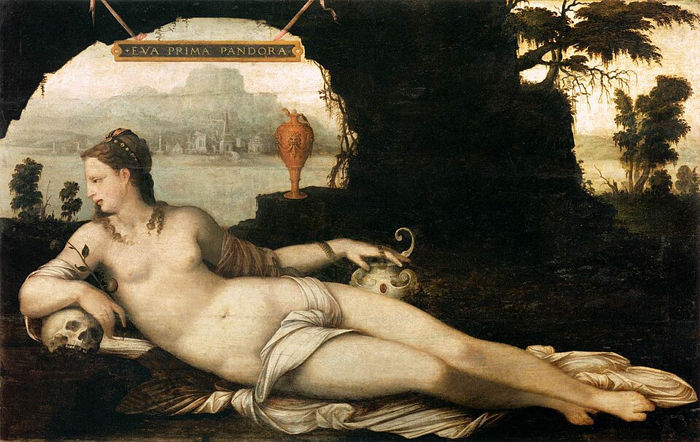
In the 16th century, French artist Jean Cousin the Elder created an extraordinary work: Eva Prima Pandora. The title itself tells us the game being played: "Eve, first Pandora."
The woman depicted combines elements from both stories. There are references to Eve, such as the serpent and the apple, but the vessel of Pandora also appears. And alongside the figure we find other symbols related to death and the human condition. This is not simply a Greek woman, nor simply Eve: it is an image deliberately constructed to blur the two figures together.
The Louvre itself identifies the work as Eva Prima Pandora and dates it to the mid-16th century. It is extraordinary visual proof that the parallel between the two figures is not a modern invention: European culture had been playing with that association for centuries.
Pandora Wasn't Simply "The Curious Woman"
The popular version of the myth tends to reduce everything to a very simple moral: Pandora was curious, she opened the box, and because of her curiosity, all the evils entered the world. But Hesiod's account is considerably more complex.
To begin with, Pandora doesn't appear on her own initiative. Zeus orders her creation, and does so within a story tied to the punishment humanity receives after the conflict between Zeus and Prometheus. In other words, Pandora is not originally a heroine who accidentally stumbles upon a mysterious box: she is a piece within a divine act of revenge.
Moreover, Hesiod dedicates considerable space to describing her creation. Pandora is not merely the person who opens the vessel: she is a figure built by the gods and presented to men as something desirable. Beauty and danger appear intertwined. And that matters, because the myth isn't only explaining how misfortunes came to be. It is also trying to explain something far more everyday for the Greeks: why human life demands work, effort, suffering, and dependence on other people.
The myth of Pandora is part of Works and Days, a work that deals precisely with labor, justice, agriculture, effort, and the difficult human condition. Modern scholarship has pointed out that Pandora plays a far more significant role within this work than one might assume from knowing only the popular "box" version.
A Woman Who Explains the World
And there lies Pandora's true power. Ancient myths did not always try to answer a historical question in the modern sense: they tried to answer far bigger questions. Why does suffering exist? Why must we work? Why do we fall ill? Why isn't human life perfect? Why are gods and men separated?
Pandora appears in the middle of all these questions. Her story turns an enormous problem — the human condition — into a scene anyone can picture: a woman, a vessel, a lid, a moment of curiosity. And suddenly, everything changes.
From Vessel to Box
Over the centuries, the myth kept transforming. Pandora was interpreted in different ways by writers, philosophers, and artists. Her story was moralized, reinterpreted, and blended with other traditions. The famous box eventually took hold in Western culture, becoming an everyday expression: today we say "opening Pandora's box" when someone sets off a chain of problems that later proves impossible to stop.
But behind that phrase lies a much older, much stranger story. Because the original object wasn't a box. And we don't even know with absolute certainty that Hope was simply the "prize" left inside. What we do know is that, for Hesiod, Pandora sits at the center of a mythical explanation for why human existence is filled with hardship.
Two Women, Two Stories
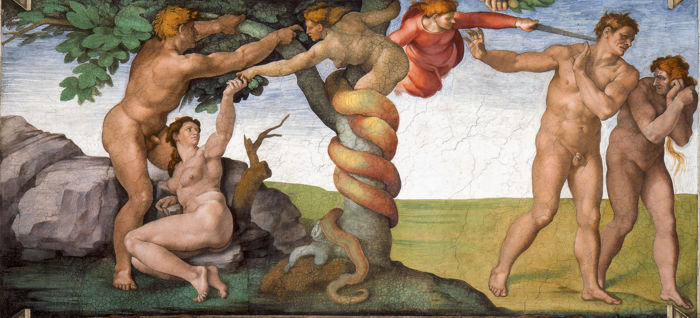
And so we return to Eve. One woman takes a fruit. Another opens a vessel. Two stories from different cultures, two first women, two transgressions that have become symbols. And two tales that imagine a moment when humanity left behind a former condition.
Perhaps that's why the comparison has proven so irresistible for centuries. Not because Pandora and Eve are the same woman. Not because their stories are identical. But because both became linked to a question that will probably never stop haunting us: at what moment did the human world stop being perfect?
Jean Cousin found an artistic answer. He didn't paint Eve. He didn't paint Pandora. He painted both. And he gave the work a title that sums up the whole mystery: Eva Prima Pandora. Eve, the first Pandora.
Two stories. Two women. And a single image to remind us that, once a door opens, some things can never go back in.