

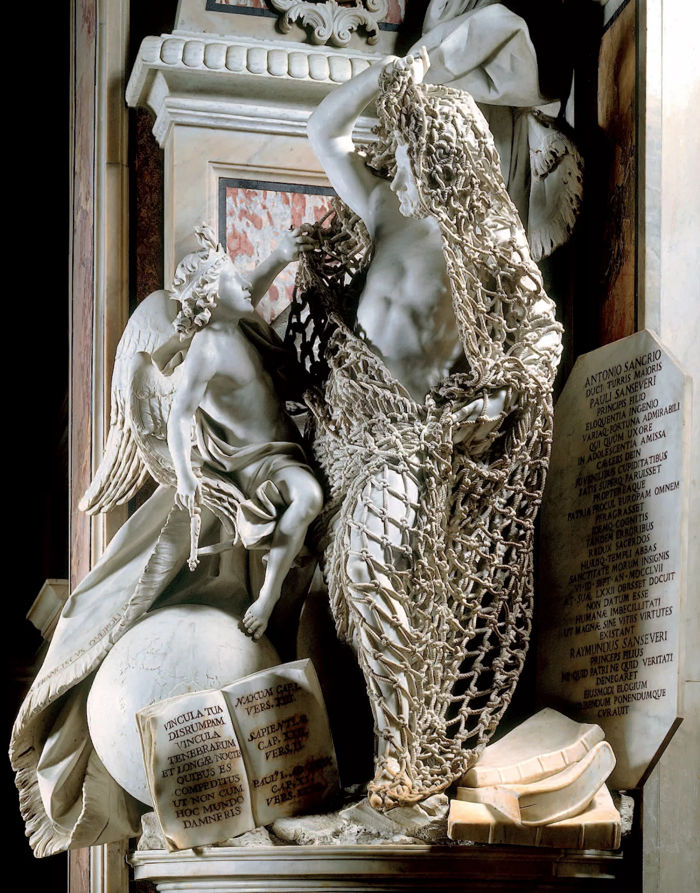
Some sculptures impress by their size. Others, by the beauty of their figures. And then there's Disillusion, a work that produces a reaction much harder to explain: it's hard to believe that what we're looking at is really marble.
Francesco Queirolo finished this sculpture in 1753-1754 for the Cappella Sansevero in Naples.
The work was commissioned by Raimondo di Sangro, Prince of Sansevero, to honor the memory of his father, Antonio, Duke of Torremaggiore. At first glance it seems like a simple scene: a man tries to free himself from a net while a small winged figure helps him. But nothing in this sculpture is what it seems. The net is not a net. The man is not simply trapped. And the small figure helping him isn't a simple angel either. It's all part of a much more complex allegory about sin, knowledge, passions, and liberation.
A story of sin and repentance
To understand Disillusion we have to start with the man depicted in it. Antonio di Sangro, Duke of Torremaggiore, was Raimondo di Sangro's father. After the premature death of his wife, according to the Cappella Sansevero itself, he led an adventurous and disorderly life. He left his son in the care of his grandfather Paolo and spent much of his life traveling through Europe. The inscription related to the monument presents him as someone subject to the "passions of youth."
But the story doesn't end there. In his old age, tired and repentant of the mistakes he had made, Antonio returned to Naples. There he spent his final years devoted to priestly life. That biographical arc is essential to understanding the meaning of the sculpture, because Disillusion doesn't simply depict a man escaping a prison. It depicts a man who comes to understand that he was trapped. And that difference explains even the name of the work: disillusion isn't only discovering that something was false, but reaching a knowledge that allows one to leave a former error behind.
Raimondo turned his father's life into a kind of moral warning: an example of that human fragility in which, according to the dedication, great virtues can coexist with vices. The sculpture is, therefore, both a family monument and a moral allegory.
The net that traps and the intellect that frees
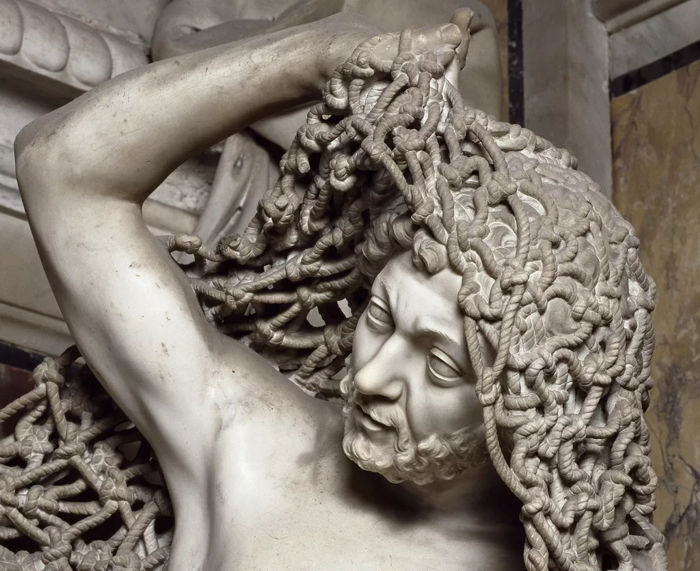
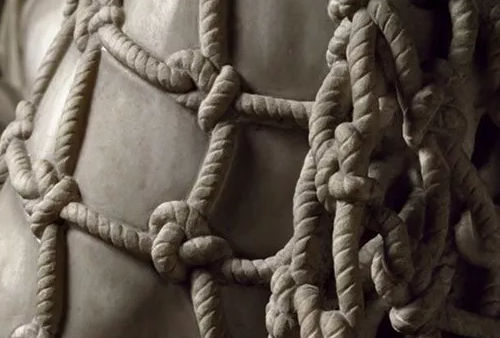
The first thing that catches the eye is, naturally, the net. It surrounds the man's body, but the truly extraordinary thing is that the net is also made of marble. Here technique and meaning become inseparable: the Cappella Sansevero Museum explicitly identifies the net with sin. The choice of a net is especially effective because it doesn't represent a conventional prison. There are no bars, no walls, no thick chains. The prison is made of something much more subtle, something that can seem light and almost harmless, but which, once around the body, prevents movement. The allegory works precisely through that contradiction, and in the sculpture that idea becomes matter: Queirolo managed to make marble look like rope, thread, and woven fabric.
The result is so convincing that for centuries this net was considered an extreme demonstration of sculptural virtuosity. Giangiuseppe Origlia, in his Istoria dello Studio di Napoli, described it as the hardest test that marble sculpture could aspire to. There's also a widely repeated story around its finishing: according to the tradition recorded by the museum itself, the craftsmen in charge of polishing were supposedly afraid to touch the delicate net for fear of breaking it, and Queirolo is said to have finished the work himself with pumice stone. It's a fascinating story, but it should be called by its name: a tradition. The museum presents it as something that "is told," not as a proven documented fact, and that difference matters.
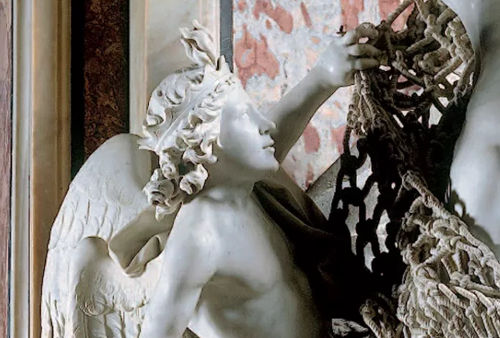
Above the man appears a much smaller figure: a winged spirit whose forehead bears a tiny flame. It's often described simply as an angel, but the Cappella Sansevero itself identifies it as a genius or winged spirit, and that detail changes the reading. The small flame on its forehead represents human intellect, knowledge, the capacity to understand. The figure doesn't arrive to destroy the net from outside: it helps the man free himself. In other words, liberation also depends on the man himself coming to understand what is holding him trapped. First comes enslavement to the passions, then knowledge appears, and finally the possibility of liberation arrives. The position of the small spirit reinforces this idea: while helping the man with the net, it points downward, toward the world.
The globe and the book: passions and revelation
At the figures' feet appears a terrestrial globe, which the Cappella Sansevero Museum interprets as a symbol of worldly passions. It's not a decorative element placed simply to fill space: it's part of the allegory's logic. The man is trapped in the net and, at the same time, stands upon that which symbolizes the world and its temptations. The direction of the winged spirit's gesture connects both things: the intellect points to what the man must move away from, and liberation means leaving behind dependence on worldly passions. It's a very clear symbolic structure: passions, enslavement, knowledge, liberation.
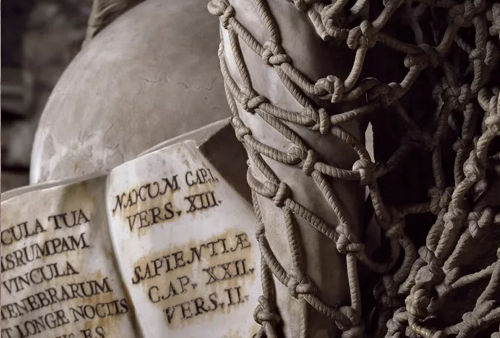
But one piece is still missing, perhaps the most important one. Resting on the globe is an open book which, according to the official identification by the Cappella Sansevero Museum, is the Bible. Its presence introduces a new dimension: up to this point we've seen the man, the net, the intellect, and the world; now the word appears, the teaching, the revelation. The Bible isn't placed just anywhere: it rests on the globe that represents worldly passions, and the symbolic reading is powerful. Above the world lies the knowledge that allows one to overcome it. The book has yet another dimension within Raimondo di Sangro's particular intellectual universe: the museum notes that the Bible was also one of the three so-called "great lights" of Freemasonry, and here we begin to enter one of the most interesting aspects of the entire Cappella Sansevero.
The blind man who regains his sight
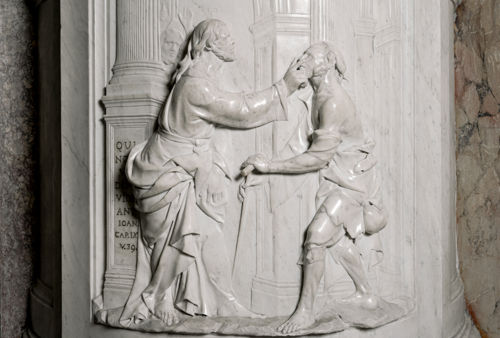
Raimondo di Sangro was a figure linked to Freemasonry, and the chapel's iconographic program contains numerous elements related to initiatory traditions. In Disillusion, this dimension appears especially tied to the contrast between darkness and light. The man is trapped and doesn't see clearly; the intellect is represented by the small flame; the book offers the teaching. And the base of the sculpture introduces another decisive image: Christ restoring sight to a blind man. The message then becomes much deeper. It's not just about physically escaping a net, but about learning to see.
On the pedestal appears a bas-relief depicting Jesus restoring sight to a blind man, and it's not a secondary scene: the museum itself explains that this episode reinforces the meaning of the main allegory. The man in the sculpture needs to free himself from the net; the blind man needs to regain his sight. In both cases there's a transformation that moves from darkness toward light. Next to the relief also appears the Latin phrase "Qui non vident videant" — that those who do not see may see — and that phrase turns the scene into something more than a biblical episode. Physical vision becomes a metaphor for knowledge: to see means to understand, and not to see means to remain trapped in ignorance.
The Cappella Sansevero Museum interprets the contrast between light and darkness, the episode of the blind man, the Latin phrase, and the biblical passages engraved in the book as a clear reference to Masonic initiation rituals, in which the initiate symbolically entered a state of darkness and then accessed a new light associated with truth. The structure of Disillusion fits that idea: first darkness, then revelation, finally liberation. But a simplification should be avoided here: the work isn't simply "a Masonic sculpture." It's a funerary, family, religious, moral, and philosophical work all at once, and the Cappella Sansevero itself warns that the symbolic program of the whole is too complex to be reduced to a single interpretation. That complexity is precisely part of its appeal.
An idea by Raimondo, carved by Queirolo
Although Francesco Queirolo is the sculptor who turned this idea into marble, there's a figure we shouldn't lose sight of: Raimondo di Sangro. The Cappella Sansevero Museum states that Disillusion was a work entirely invented by the prince and completely new in its genre, while art-historical sources such as Treccani note that Raimondo conceived the chapel's complex iconographic program. Queirolo was, therefore, the extraordinary executor of an idea that was part of a much larger project: the Cappella Sansevero wasn't conceived as a simple collection of sculptures, but as a set in which the virtues, the funerary monuments, the religious references, and the symbols tied to knowledge form part of a program through which Raimondo sought to turn the family chapel into something like an intellectual and spiritual journey. In that context, Disillusion holds a special place, because it represents the moment in which the man manages to free himself from what dominated him.
The true subject of the sculpture
There's something especially beautiful in the sculpture being called Disillusion: the man isn't simply being saved, he's undergoing disillusion. The world that surrounded him — represented by the globe — no longer holds the same power over him. The net that once trapped him begins to disappear, the intellect guides him, the book offers knowledge, and the blind man on the pedestal reminds us that there's a fundamental difference between looking and seeing.
In that sense, the true subject of the sculpture isn't the net. The net is only the visible image of something much more abstract: the possibility that a human being might recognize their own mistakes and change. That connects directly to the story of Antonio di Sangro, whose life had been marked, according to the dedication itself, by the passions of youth, but who ended up seeking a different life. Raimondo turned that personal journey into an allegory that could apply to anyone. We can all end up trapped. We can all mistake desire for freedom. And we can all need, at some point, to learn to see differently.
That's why Disillusion works on two levels at once. The first is purely visual: we look at the net and can't understand how it can be made of marble, how the stone seems to turn into something soft, flexible, and almost transparent. The second level appears once we begin to understand what we're looking at: the net stops being a technical feat and becomes sin; the globe stops being a globe and becomes the world of passions; the flame becomes the intellect; the book becomes knowledge and revelation; and the blind man becomes the image of one who finally manages to see. Everything is connected, and perhaps that's the reason this sculpture makes such a powerful impression: Queirolo didn't use his virtuosity merely to prove he could make marble look like a net, but to turn an abstract idea — the enslavement of sin and the possibility of liberation through knowledge — into something we can see with our own eyes.
The man is trapped. But he has already begun to free himself. And perhaps that's the true meaning of Disillusion: not in the moment we discover we were wrong, but in the moment after — when we finally manage to see the net that had us trapped.
THE WORK
Disillusion
Artist: Francesco Queirolo
1754
Cappella Sansevero
Sansevero Chapel
Naples, Italy