

Some paintings are simply looked at. Others are wandered through. And then there's The Garden of Earthly Delights, by Hieronymus Bosch, a work so dense with details, creatures, and symbols that not even five hundred years of study have managed to fully agree on what it actually means.
Painted between 1490 and 1500 on oak panel, this triptych is Bosch's most ambitious work and, today, the most visited piece in the Prado Museum. But before diving into its three interior panels, we have to start where almost no one looks: on the outside.
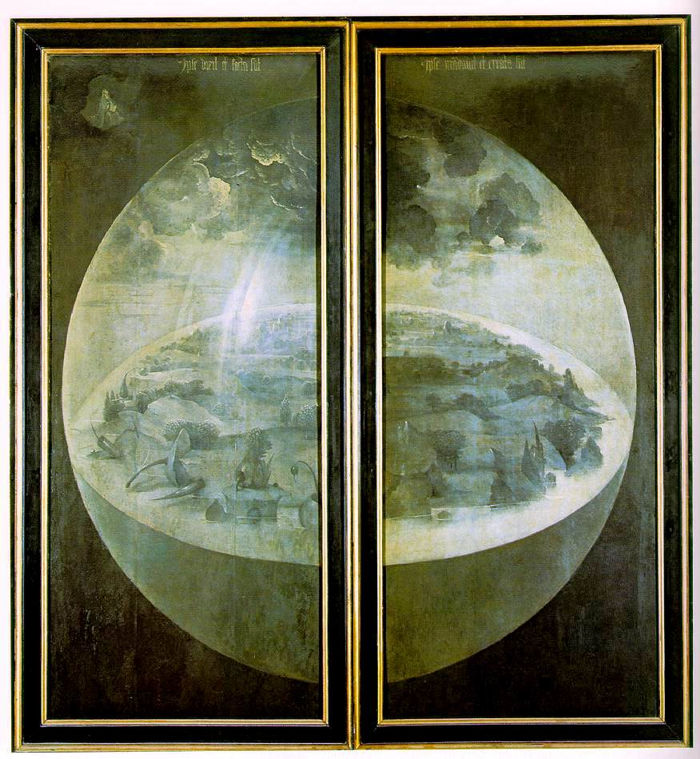
The Closed Triptych: The Creation of the World
When the triptych's wings are closed, they reveal a scene entirely different from the one everyone knows. Painted in grisaille — a technique that uses a single color to simulate relief and volume — the exterior cover shows the third day of Creation, the exact moment when the waters separated from the earth and the earthly Paradise appeared.
The newly formed Earth appears enclosed within a transparent sphere, floating in a gray void. In the upper left corner, tiny in comparison to his own creation, God the Father watches over the scene. Two Latin inscriptions, taken from the Psalms, accompany the image: "He spoke, and it was done; he commanded, and it stood firm." It's a quiet, almost solemn overture for what is about to explode into color the moment the doors open.
The Garden of Eden (Left Panel)
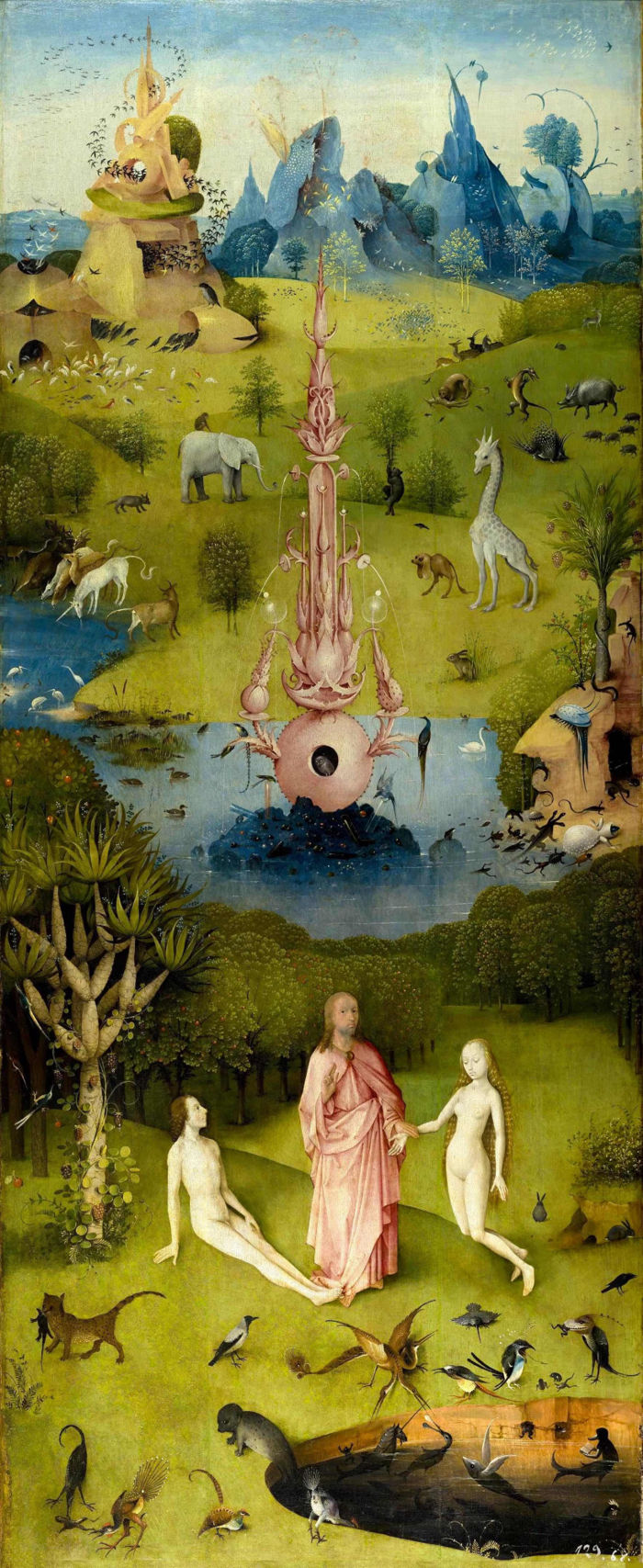
Opening the triptych, the first panel places us in the Garden of Eden, at the exact instant God presents Eve to Adam. The traditional reading of the work moves from left to right, so this panel serves as the starting point for everything that follows.
Around the central scene, Bosch unfolds a catalogue of fantastical, hybrid, and impossible creatures emerging from a pond, in what many art historians read almost as a painted, premonitory version of the evolution of species: amphibians making their way from water onto land. At the center of the composition rises the Fountain of Life, and perched above it sits an owl, a symbol loaded with ambiguity in medieval Flemish iconography — associated with both dark wisdom and heresy — alongside a peacock, which represented the opposite: salvation. Even from this first panel, Bosch makes clear that nothing in this work is merely decorative.
The Garden of Earthly Delights (Central Panel)
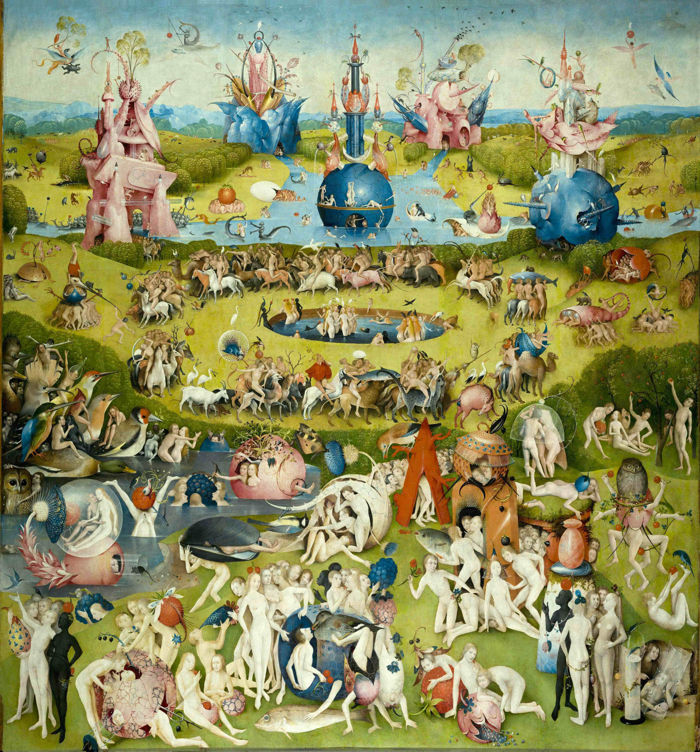
The panel that gives the whole work its name is also its most bewildering. Hundreds of naked figures coexist in an impossible landscape, given over to every kind of pleasure: embracing, bathing, riding giant animals, wandering inside bubbles and oversized fruit. Strawberries — fruit that spoils almost as soon as it ripens — appear again and again throughout the panel, working as a recurring metaphor for pleasures as intense as they are fleeting.
Specialists agree that this panel allows for at least two major readings, and not necessarily contradictory ones. On one hand, it can be read as a moral warning: humanity indulging without restraint in worldly desires, moments before paying the consequences in the next panel. On the other, as an allegory of Paradise lost, a vision of what existence without guilt or sin might have looked like. Bosch never left a key that resolves the ambiguity, and that very ambiguity is, in large part, what has kept the fascination with the work alive for centuries.
Hell (Right Panel)
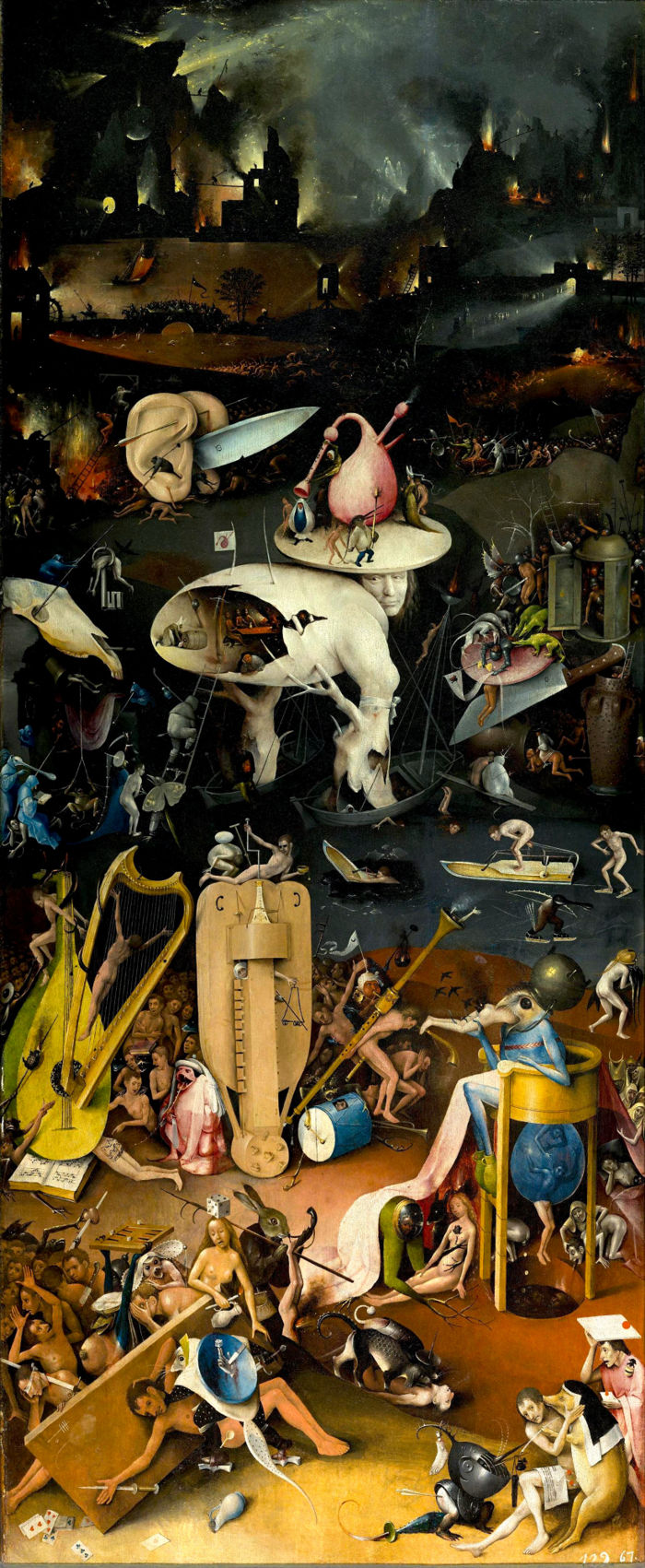
If the central panel dazzles, the right panel terrifies. Here, Bosch builds one of the most original and influential visions of hell in the history of art: an inverted, dark, musical world, where instruments — lutes, harps, bagpipes, drums — stop being symbols of pleasure and become instruments of torture.
Below, among gambling tables and scattered dice and cards, gambling and vice are condemned. Higher up, a monstrous being wearing a cooking pot as a crown — sometimes described as the "great king" of this upside-down world — devours sinners only to expel them again, in an endless cycle of punishment. One famous detail is the so-called "Tree-Man," a figure with a hollow trunk turned into an infernal tavern, his face turned toward the viewer; several scholars suspect this may be a disguised self-portrait of Bosch himself. Another unsettling detail: a pair of giant ears, pierced by an arrow and a kind of knife, float bodilessly over the scene — a symbol, most likely, of the cruelty of words and gossip.
A Continuous Landscape
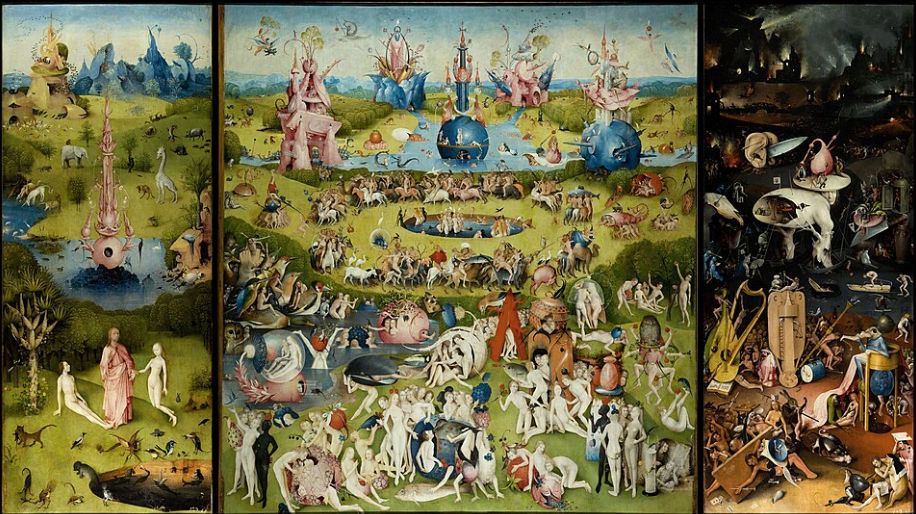
There's a detail that almost always goes unnoticed, because it requires seeing the entire work from a distance — something nearly impossible in front of the original: the three interior panels share a single horizon line. Eden, the garden, and damnation are not three isolated scenes, but a single panoramic landscape running through the whole work, as if time itself — from Creation to final punishment — unfolded within one continuous space.
A Commission With No Church, and a Winding Fate
Despite its religious subject matter, everything suggests that The Garden of Earthly Delights was never intended for a church or monastery. The explicit nature of its central and right panels makes it practically impossible that it was conceived as a liturgical altarpiece; historians agree it was commissioned by a lay patron, though his exact identity remains unconfirmed.
The work later passed into the hands of the House of Nassau and, afterward, the Spanish Crown, possibly during the reign of Philip II, a great admirer of Bosch. It remained in royal collections for centuries, until in 1939 it was permanently incorporated into the Prado Museum's holdings, where today it remains, by far, the most visited work in the collection.
A Mystery That Remains Open
More than five centuries after it was painted, The Garden of Earthly Delights still has no single, definitive interpretation. Each new generation of art historians finds new symbols, alternative readings, details that had previously gone unnoticed. And perhaps that is, at its core, Bosch's true genius: having built a work so meticulous and so ambiguous at once that not even the most rigorous art scholarship has managed to fully exhaust it.
THE ARTWORK
The Garden of Earthly Delights
Artist: Hieronymus Bosch
c. 1490-1500
Technique: Oil on oak panel (triptych)
Dimensions: 205.5 x 384.9 cm.
Museum: Museo Nacional del Prado
Madrid, Spain